“Stay Curious”: A Scientist’s Message to the Next Generation of Girls in STEM
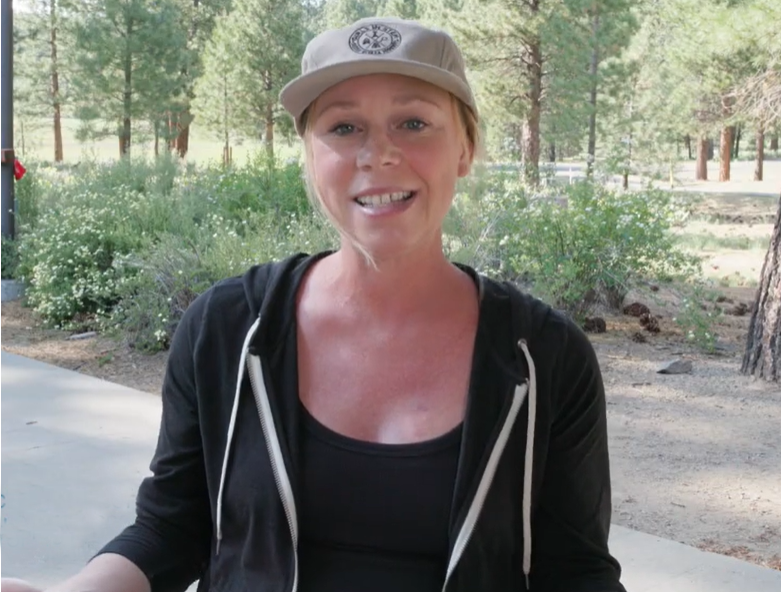
Anne Heggli didn’t follow a straight path into science — and that’s exactly what she wants girls to understand.
Standing outdoors at Sierra Nevada Journeys Outdoor Education Camp, surrounded by mountain air and the lingering chill of snowpack, she introduced herself simply: “My name is Anne Heggli. I’m an assistant research professor in mountain hydrometeorology at the Desert Research Institute.” But her story stretches far beyond a job title.
“I actually want to hang out and chat with the Sierra Nevada Journeys staff at the end of the day,” she joked warmly, her easygoing tone reflecting the kind of scientist she is approachable, grounded, and deeply connected to the world she studies.
Her connection to weather and water began long before her career. “I grew up on the divide between the Middle Fork and the South Fork of the American River in Cool, California,” she said. Seasonal storms weren’t abstract concepts; they were lived experiences. “When we’d get those rain-on-snow events, it would flood, and we wouldn’t be able to get to town.” Her father, she added, “did work in cloud seeding,” so conversations about weather and water were always part of her life. “I’ve always been around it.”
Still, her journey into science wasn’t direct. “My route to being a scientist was very, very non-traditional,” she explained. “I studied a lot of different topics and was interested in a lot of things growing up.” In fact, she first earned “an undergraduate degree in international relations in Spanish.”

It wasn’t until she began working in Latin America alongside her father, a meteorologist, that something clicked. “I was really drawn to the questions and the problems that were trying to be solved,” she said. More than that, she saw the impact. “I liked the application of putting the work into trying to help improve people, manage their water resources, and also understand meteorological events that impact their communities.”
At Camp, Anne brought that same sense of purpose to the girls she worked with at Girls in STEM, along with hands-on tools. “One of the main things that I work on is measuring the snowpack,” she said, holding up specialized equipment. Among them, a Federal Sampler, a professional-grade, portable tool used to measure snow depth and density to determine Snow Water Equivalent (SWE). “The original design was developed in 1906 on Mount Rose (the highest mountain in Washoe County within the Carson Range of Nevada),” she explained, “and it’s still our gold standard for how we measure the snowpack today and predict our runoff.”
With the tools, the girls could measure the amount of water in the snowpack, the density, and also the temperature. But the magic came once they looked deeper. “We can start looking at all the different layers as if it were tree rings in a tree,” she said. “We can kind of get the story of all of the events and storms that came through that winter.”
For Anne, science isn’t just data; it’s storytelling written in snow.
That sense of discovery is exactly why she believes being at Girls in STEM Camp matters. “Sometimes these scientific or STEM-type careers might seem very cookie-cutter,” she said. “There are only a couple of ways or approaches to it.” But her own work tells a different story. “There’s actually a really broad spectrum of the work that can be done.”
In her role, she collaborates with the National Weather Service, studies snowpack, and spends time outdoors. “I get to play outside and spend my time working outside,” she said with a smile. “I would like for the girls to be able to see that you can do whatever it is that you want if you’re really passionate and curious about it. And it can look any way.”
More than anything, Anne hopes to leave the girls with a mindset rather than a specific career path. “As a woman in STEM, I want to help them foster that sense of curiosity.”
In a world that often emphasizes results and output, she sees something missing. “So much of the education focus is on the quantity of what we learned,” she said. But learning, to her, is something much bigger. “Becoming a lifelong learner, you can learn as you get older and as you grow. Learning should just be something that’s fun.”
Out in the mountains, where science lives in snow layers and storm patterns, Anne Heggli is showing the next generation that curiosity doesn’t have to follow a straight line and that sometimes, the most meaningful discoveries begin simply by asking questions.