
For Sierra Nevada Journeys Participants, Nature Is a Good Classroom
Originally published by Pat Hickey, Author and Columnist, Reno Gazette-Journal, published 12:01 p.m. Nov. 25, 2024 | Updated 12:17 p.m. PT Nov. 25, 2024; https://www.rgj.com/story/opinion/2024/11/25/for-sierra-nevada-journeys-participants-nature-is-a-good-classroom/76571691007/
America’s education system was created in the 1800s. Some would say it’s in need of a tuneup, or even a major rebuild. I’d be one of those. And so are the innovative folks who started Sierra Nevada Journeys, an outdoor learning camp that teaches science utilizing Mother Nature, and life skills using human-created ropes and barriers on challenge courses, to thousands of area students.

Some experts argue that traditional classrooms are considered outdated for children’s education, primarily because they often lack flexibility, fail to cater to individual learning styles, and do not adequately prepare students for the demands of a rapidly changing world which requires skills like critical thinking, collaboration and adaptability — which are not always emphasized in a traditional classroom setting.
For centuries, children have been confined in crowded classrooms and taught the same standard things: reading, writing, math, science and history. Even though the knowledge and skills gained from these educational building blocks are crucial parts of a young person’s education, they aren’t always best understood in a drab setting seated in confining desks taught by a “sage on the stage,” who can’t possibly paint a picture of biology quite like a meadow and a pond with live tadpoles can.
Founded in 2006, Sierra Nevada Journeys Outdoor Education Camp is located on 515-acres, just north of Reno in Plumas County, California. More than 10,000 students a year from Nevada and northern California attend their innovative outdoor, science-based education programs for youth to “develop critical thinking skills and to inspire natural resource stewardship.” In other words: Kids are out of the classroom, frequently in overnight experiences with their teachers and fellow students learning about nature, and — just as importantly — themselves.
I visited the camp recently and witnessed students and their teachers wandering the nature trails, cleaning the cafeteria where they eat, and navigating rope courses and climbing barriers meant to teach them trust and many of the skills they’ll face later in Real Life 101.
Spending the afternoon interacting with students and staff at the camp, I witnessed an unbridled joy in student groups, some of whom are staying in the camp setting for two nights, unhooked from their cellphones, to the delight of teachers and students alike. Tall trees housing zip line courses and wood bench amphitheaters appear to have more than enough allure — at least for the time being — to cause kids to forgo their constant-companion digital devices.
Sierra Nevada Journeys CEO Sean Hill has the innate passion of an outdoors enthusiast who appears to be enjoying the experience as much as kids from urban settings do. For many of the campers, it’s their first venture into nature. Sean, who tells me he would rather be “the guide on the side” than “the sage on the stage,” explains the three main focuses of the camp’s programs are “critical thinking, connecting to the outdoors, and youth development.”
Jonathan Haidt, the famed social psychologist who has gained notoriety in writing about political polarization and getting rid of cellphones in classrooms, writes in his book, "The Coddling of the American Mind": “Before the 1990s, kids experienced more risk, more thrills, more physical injuries, and fewer psychological injuries than they do today. Kids had more freedom to make mistakes and learn from them.”
Students who attend the camp experiences at the Camp get to experience a little of both, with the exception of physical injuries which are rare or non-existent in the Challenge Course which involves highly monitored climbing on towers with ropes, ascending barriers and trust-creating activities that often lead to an indelible impression on the mindset of a growing young person.
Commenting on the experience of the Challenge Course, students say:
“You made school a thousand times better. My favorite day was the challenge course.” – Austin, student, Overnight Outdoor Learning
“The wall on the challenge course completely changed my view on teamwork!” – Gigi, student, Overnight Outdoor Learning
"Camp is so amazing the way you bring people who would never be friends; then, we went to camp and became friends.” – Morgan, student, Overnight Outdoor Learning
It’s why a foray from the unnatural world of four-walled classrooms into the living ecology on a Sierra Nevada mountainside is such a revelation and learning tool for many of the students whose classes sign up and attend.
An experience in nature with peers outside of the usual social constraints seems to leave a lasting benefit for students when they return after the camp to the traditional classroom.
Even Horace Mann, who championed the idea of a universal public education system in the United States, once wrote: “A teacher who is attempting to teach without inspiring the pupil with a desire to learn is hammering on cold iron.”
No cold iron appears to be a problem to the students attending one of the science camps at Sierra Nevada Journeys:
“I learned that you can’t see colors in the dark and also how to identify different bugs using a dichotomous key.” – John, student, Overnight Outdoor Learning
“My favorite part of the field trip was the night hike. I learned that animals that can see in the night are called nocturnal.” Chris, student, Overnight Outdoor Learning
Bella, a student at Overnight Outdoor Learning, said she learned that “the sun is the closest star to Earth.”
It would seem that fires *besides the one’s campers sit around before sleep takes over after of strenuous activities) gets lit more easily in the minds of attending students in these natural settings.
Dan Klaitch, a Sierra Nevada Journeys board member and past chancellor of the Nevada System of Higher Education, understands how important it is to unlock the desire for learning: “You and I have had the privilege of growing up with the incredible beauty of the Sierra all around us. It is difficult to realize that there are so many young men and women in our communities who have not had that experience. It is humbling when kids see stars in a blackened sky for the first time, or catch a tadpole. All this happens in an environment where we stress teamwork, respect and an understanding of our obligation to steward our environment for generations to come.”
Seems like a win-win for both students and their schools. Thousands of students from WCSD schools, public charter schools and private religious schools attend programs at the rural facility each year.
The 18th-century English poet William Wordsworth wrote: “Come forth into the light of things, let nature be your teacher.” We would be wise to give the next generation every opportunity to experience that in our own beautiful backyard.
As a 501(c)(3) not-for-profit, Sierra Nevada Journeys raises scholarship funds for local youth to participate in overnight programs. For every donation made by a new Nevada donor until the end of the year, your gift will be matched, dollar-for-dollar, up to $10,000. Go to sierranevadajourneys.org if you wish to donate.


"Memo from the Middle" is an opinion column written by RGJ columnist Pat Hickey, a member of the Nevada Legislature from 1996 to 2016.
Community Agreements - Toilet Paper Rolls
Discipline: Team Building and Community Agreements*
Age Range: 10+
Estimated Time: 20-30 minutes
What you need: Empty toilet paper rolls; scissors; string, tape or rubber bands; markers, pens, or paint and paintbrushes; stickers; and any additional art supplies you would like for decorating; and tape (optional)

*Community agreements are created as a way to establish a mutual understanding or make a set of expectations for all members of a community to abide by. They can be based on many things, such as how to support each community member and how to make everyone feel included. Please see What is a Community Agreement? blog post before starting this project.
Instructions:
1. Collect crafting materials and remove any excess toilet paper from rolls.

2. Use a different toilet paper roll and cut into segments — one segment for each community member. Feel free to use multiple rolls if you have a large community!

3. Give each community members their toilet paper roll segment. Have them add their name and decorate it to highlight their individuality within the community.

4. Designate one toilet paper roll for your community name and values. Collaborate with community members to decorate this community roll and add words or pictures that represent your agreement

7. Option A: Have an adult use scissors or another sharp object to poke small holes in the main roll and each individual’s segments. Pull string or other hanging material through the hole in the main roll and individual roll and tie a knot to secure the end.


Option B: Use tape or glue to attach string ends to the main roll and individual segments.


6. Enjoy your final product!


Stuart Golder Joins Sierra Nevada Journeys as Director of Donor Relationships

Stuart Golder, MA, CFRE, Director of Donor Relationships, Sierra Nevada Journeys
Stuart Golder, MA, CFRE, has joined Sierra Nevada Journeys as the Director of Donor Relationships. As a member of the Advancement team, Golder is spearheading key donor relationships. He has devoted his professional career to program and fund development for nonprofits, higher education, and healthcare. Over the last 25 years, Golder raised funds for the Children’s Cabinet, the University of Nevada, Reno, Truckee Meadows Community College, and Renown Health Foundation, focusing on family services, education, and healthcare.
"We are excited to welcome Stuart to our organization. Our commitment to world-class science and outdoor education for underserved youth requires community investment, and Stuart is a natural fit to help communicate our mission and develop new partnerships for support," said Sean Hill, President and CEO of Sierra Nevada Journeys.
Golder's connection to Sierra Nevada Journeys began when his daughter attended Overnight Outdoor Learning in middle school, followed by several summers at camp. "I was familiar with Sierra Nevada Journeys through my daughter's engagement in the overnight camp programs. However, in recent months, I've had the chance to delve deeper into the organization, and I've discovered a true gem," Golder stated. "One of my first visits to camp was able to attend the employee awards ceremony and I was touched by the team's passion and commitment to delivering high-quality STEM programs to youth. I am excited to represent Sierra Nevada Journeys and the great work being done here."
Golder’s expertise spans major gifts, donor engagement, grant writing, planned giving, endowments, and capital campaigns. He is eager to support the students and staff at Sierra Nevada Journeys to expand the region’s STEM and environmental education programs.
Stuart earned his Certified Fund Raising Executive (CFRE) credential and served as president of the board for both the Sierra Chapter of the Association of Fundraising Professionals and the Planned Giving Round Table of Northern Nevada.
If you're interested in meeting Golder for coffee and conversation, please feel free to contact him at 775.355.1688 or stuartg@sierranevadajourneys.org.
CEO Sean Hill Sits Down with Roadtrip Nation to Discuss Careers in the Outdoor Education Field

When students are in the classroom, they are often asked what they want to be when they grow up. They are told to dream big and that anything is possible. While some students will choose a more aspirational career, like a dolphin trainer-slash-ballerina, others will choose to mirror the jobs of those they look up to — their teachers. The need for teachers, and the encouragement for students to pursue teaching roles is needed now more than ever. While a career in education is full of possibilities, the roadmap to becoming a teacher is not always clear, nor do all teaching jobs look alike.
That’s why Teach For America and Strada Education Foundation fueled a Roadtrip Nation initiative to send three young adults on a free journey across Nevada to explore exciting new ideas, programs, and communities that are creating a new worldview of education in their own backyard. Along the way, they talked to inspiring professionals in education, legislature, the nonprofit sector, and other fields to get the advice they need to carve out their own paths in the state they call home.
And who better to talk about a unique career in education than our own Sean Hill.
Sean sat down with Roadtrip Nation to discuss his origins in education, and how it led him to his current role as CEO of Sierra Nevada Journeys. Hailing from Colorado, Sean has always had a love for the outdoors. He holds degrees focusing in environmental sciences, but really learned just how important outdoor education is when he found himself teaching in a windowless classroom in Houston, Texas. This led him to fully pursue outdoor education, so that students would be able to learn about the natural world without the boundaries of the traditional classroom setting.
Beginning in 2009, Sean spent the first eight years of his time at Sierra Nevada Journeys focused on education, first as an educator in the field and then as a curriculum developer, to finally training incoming educators. Sean’s firsthand experience of Sierra Nevada Journeys’ programs gave him the perfect foundation to progress through leadership roles in the organization, eventually shifting his focus to partnerships and the overall growth of Sierra Nevada Journeys. Sean shared openly that he doubted his own abilities at first when he stepped into the role of CEO, but credits his connection to nature and the mental health benefits that come from spending time in nature as factors that helped him as he settled into the role.
Sean’s progression through Sierra Nevada Journeys is inspiring, especially for the students who participate in our programs and are igniting their love of science and the outdoors. We hope that his story will inspire today’s students to become the leaders of tomorrow, and stewards of the environment.
Watch Sean’s full interview, and to explore more about Roadtrip Nation.

Behind-the-scenes at Oxbow Nature Area in Reno, Nevada, with Roadtrip Nation.
Community Agreements - Friendship Bracelets
Discipline: Team Building and Community Agreements*
Age Range: 10+
Estimated Time: 20+ minutes
What you need: Scissors, string or thin yarn a binder clip or tape
*Community agreements are created as a way to establish a mutual understanding or make a set of expectations for all members of a community to abide by. They can be based on many things, such as how to support each community member and how to make everyone feel included. Please see What is a Community Agreement? blog post before starting this project.
Instructions:
1. Have each community member choose a string that will represent what they bring to the community, or what they would like to see in their community.

2. Cut strings long enough to fit as a bracelet and tie them together in an overhand knot at the end. Two feet should be a good length with which to start.

3. Clip or tape the strings onto something stable, such as a clipboard or chair.
4. Put the strings in the order that you want the colors to be in. The string furthest to the left will make the first row.
5. Take the first string (light blue in the picture below) and put it across on top of the second string (red) so that it looks like the number 4. Be sure to cross OVER the second string, not under it.
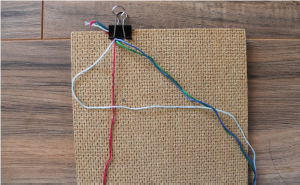
6. Wrap the tail end of the string (light blue end on the right) around the second string (red) and pull through the window you just made. Tighten the light blue string and move the loop up to the top of the bracelet while holding the second string (red) taught. Make a second loop by pulling the first string (light blue) around the second (red), the same way the first knot was tied.

7. Continue step 6 with each color of string, tying two loops around the strings to the right of the color you’re working on.
Example:
Light blue -> Red (2x), Green (2x), Dark blue (2x)
Red-> Green (2x), Dark blue (2x), Light Blue (2x)
Green-> Dark blue (2x), Light blue (2x), Red (2x)...etc.

8. Continue this process with the rest of the colors until the bracelet is long enough!

9. Wear the bracelet to remind you about what your community represents to you.
Helpful Hints: If you are having trouble following along with these instructions, there are many online videos that may be helpful! Here are a few:
DYI: 4 Easy Friendship Bracelets | Jada Draper
DIY Friendship Bracelets for Beginners | Craft Factory
Community Agreements - Using Construction Paper
Discipline: Team Building and Community Agreements*
Age Range: 10+
Estimated Time: 10-20 minutes
What you need: Construction paper; markers, pencils or paint; scissors; and tape or glue

*Community agreements are created as a way to establish a mutual understanding or make a set of expectations for all members of a community to abide by. They can be based on many things, such as how to support each community member and how to make everyone feel included. Please see What is a Community Agreement? blog post before starting this project.
Instructions:
1. Start with construction paper and grab some fun colors!

2. Choose two colors. Trace out a tree trunk and a tree top in any color you like.

3. Combine on to a background. Glue or tape tree on a larger piece of construction paper.

4. Add to the tree. Trace and cut out apples, fruits, treen nuts, squirrels and any other things that you might find on a tree.

5. Add values. Have everyone who is part of your community agreement add different values they believe are important for your community.

Exploring Outdoors at Oxbow Nature Observation Area in Reno
There are many wonderful places to visit in the Reno/Sparks area where you can get outdoors and learn about nature. One of our favorite locations is the Oxbow Nature Observation Area, 3100 Dickerson Road, Reno, Nevada. Located just west of downtown Reno, Oxbow is one of our field sites for Classrooms Unleashed.

In a 1-hour visit, you’ll be able to see some amazing wildlife and enjoy the fresh air safely and at a distance from other guests. It is a 0.8-mile trail loop within 22-acres of nature study area. Also, it’s good for all skill levels and accessible year-round.

The park is open daily from 8 am until sundown; it is best to visit the park early in the day to avoid crowds. Please note there are no dogs allowed, and it is easy to access with plenty of on-site parking. As you start the trail, take note of the signs at the trailhead as they explain why the park is called Oxbow and some of the wildlife you might see.

Picnic area located at the end of the trail.
As you travel down the trail, you will quickly come to a fork in the road that gives you three options: left toward the main trail; right toward a nice observation of the oxbow — a U-shaped curve in the Truckee River; or up, which leads you to an observation deck. We recommend that you start with the trail leading “up” as it gives you a bird’s eye view of the park. Speaking of birds, Oxbow is a wonderful place to go for bird observation. This year alone, 76 different species of birds have been observed at the park, making it a great destination to be introduced to animal observation. You might also see a wide variety of squirrels, snakes, and even deer.

After the stop at the observation deck, you will pass by the Truckee River, a great place to make even more observations! The rest of the trail is linear and should be easy for you to navigate. You will know you have reached the end of the trail when you reach the picnic area (see photo), which is a great place to sit down, eat a snack, and enjoy the nature around you.
Take a moment at the picnic area to sit still for a moment and see what you can observe. On your way back to the parking area, make sure to stop by the small deck by the river as it boasts a beautiful and expansive view.
NOER grant helps girls in STEM get outdoors in Northern Nevada
By Sean Hill, President and CEO of Sierra Nevada Journeys

Saturday, Sept. 28, celebrates National Public Lands Day and Nevadans have also dubbed it Nevada Public Lands Day. In Northern Nevada, we want our children to have a chance at the opportunities provided by local industry to lead in STEM, outdoor, and conservation careers. Careers that pay well and protect our public lands. But we know that far too many of our girls are hitting a green glass ceiling, with only 10% of women in green jobs.
We at Sierra Nevada Journeys want to be a part of the solution to this crisis.
Based in Reno, Sierra Nevada Journeys is a nonprofit organization for Nevada students focusing on innovative outdoor, science-based education programs that develop critical thinking skills and inspire natural resource stewardship.
We were one of 23 unique programs chosen in 2024 for the Nevada Outdoor Education and Recreation Grant Program (NOER), a bill passed in the 2019 legislative session. The grant helps us provide outdoor experiences for students. NOER awarded these programs over $250,000 in 2024 in nearly every county.
We used this funding to support our “Girls in STEM" program. Specifically, this funding allowed us to provide transportation for the girls from Reno to our Outdoor Education camp for science and outdoor learning one weekend this past spring. The girls built self-confidence in STEM, and the program helped connect them to women who are leaders in STEM and green careers like engineering, education, and technology. Girls in STEM also featured youth development and collaborative problem solving on the Sierra Nevada Journeys high-hopes challenge course kayaking, outdoor exploration, and STEM activities.
We’ve been working closely with leadership from NOER since early in the agency’s inception. Sierra Nevada Journeys has both sought feedback and provided perspective and context around our efforts at reducing barriers to access to outdoor education for youth in Nevada.
We are grateful for this grant funding and the opportunity it offers our children. We know that this camp plays a role in helping more girls become leaders in STEM and in good-paying, green jobs. We also know that there needs to be continuous support for programs like NOER so these girls can return to camp as leaders and mentors to support the next generation of Nevada’s decision-makers.
Thank you Nevada Conservation League for helping us spread the word about conservation and protecting Nevada’s natural resources.
What is a Community Agreement?
Discipline: Team Building and Community Agreements
Age Range: 10+
Estimated Time: 20-60 minutes
What you need: Any crafting supplies you want to use. You can be really creative and use whatever feels the most inclusive for the group with whom you are working. Are you low on art supplies? See the community agreement project posts for ideas on how to create a community agreement using your computer or everyday household items.

Introduction: Community agreements are created as a way to establish a mutual understanding or make a set of expectations for all members of a community to abide by. They can be based on many things, such as how to support each community member and how to make everyone feel included. Some communities may struggle to get along with each other when there are shifts in normal dynamics. For example, those sharing living spaces may currently be experiencing increased tension or conflicts due to spending much more time together in a confined space. A community agreement can be beneficial to help dissolve these problems, as it allows everyone to freely express their wants, needs, and expectations in a group setting.
Instructions:
There is no one right way to design these agreements. Please see our example blog posts for further details on creative ways to engage all community members in the making of your agreement. What are the steps to create your own community agreement? Follow these steps:
1. Determine who is in your community. A community is defined as a group of people who share something in common. Some examples may include:
- Your family
- The people who with you
- A sports team you are on or club you are in
- A classroom with students and teachers
- A workspace including bosses and coworkers
A community can be small or large; it depends on how you define it!
2. Allow everyone in your community to have space to contribute what they want in the agreement and be heard. One method could be to share values or expectations in a circular format, allowing each person involved to bring up one thing they want to be included in the agreement at a time.
3. Time to get creative! Depending on what you have in your space, you can get crafty with paper, paint, rocks, string, beads, etc. If craft supplies are limited, try keeping it simple and reuse household items for your visual representation. Try repurposing toilet paper rolls, tissue boxes, glass or plastic containers, etc. We will provide some examples in the following blog posts if you are feeling stuck!
4. Display your agreement somewhere where it is easily seen so that each community member can be reminded of what they agreed to regularly. You can refer back to it when you feel like your community may not be fulfilling the agreement, or when you think you are following it very well! Positive reinforcement is a great way to highlight your agreement, so remember to give appreciation to those in your community who are actively working to follow it.
Social Emotional Learning. What Is It and Why Is It Important?

If you have a school-age child, you may have heard about Social-Emotional Learning (SEL) through your school or their teachers as the term has gained popularity in formal education. Additionally, it has been an integral component of learning at residential environmental education centers (outdoor schools) like Sierra Nevada Journeys outdoor program at our Outdoor Education Camp.
Our Overnight Outdoor Learning program has been an extension of regular classroom programs with schools. Held at the beautiful Camp in Portola, California, Overnight Outdoor Learning is designed for fifth- and sixth-grade students and includes STEM, teambuilding, and SEL components. When students attend the 3-to-5-day program, we use the outdoors as their classroom and they learn using experiential, hands-on approaches. They are encouraged to use critical thinking by asking questions, making observations and conducting investigations.
One of the key components of Overnight Outdoor Learning is SEL defined as,
“The process through which children and adults understand and manage emotions, set and achieve positive goals, feel and show empathy for others, establish and maintain positive relationships, and make responsible decisions.”
- Collaborative for Academic, Social, and Emotional Learning (CASEL)
Why is SEL important?
SEL provides a foundation for safe and positive learning and enhances students' ability to succeed in school, careers, and life.
Research shows that SEL not only improves achievement by an average of 11 percentile points, but it also increases prosocial behaviors (such as kindness, sharing and empathy), improves student attitudes toward school, and reduces depression and stress among students (Durlak et al., 2011).
During the coronavirus pandemic, many youth may be experiencing stress and anxiety. They may feel disconnected from others due to quarantine and schools being closed. The need for SEL is rising due to these circumstances.
Ask your school about SEL programs that they may offer. Since 2012, the Washoe County School District has been using SEL strategies as a way to increase graduation rates.
Through Washoe County School District’s Parent University, you’ll find regularly scheduled SEL courses to help parents engage in SEL practices, such as College and Career Success and Building Resiliency in Children.
Sacramento City Unified School District’s SEL at home is a great place for parents to learn SEL principles that they can do with their children. They include:
1. Focus on strengths.
2. Follow up with a consequence for misbehavior.
3. Ask children how they feel.
4. Find ways to stay calm when angry.
5. Avoid humiliating or mocking your child.
6. Be willing to apologize.
7. Give children choices and respect their wishes.
8. Ask questions that help children solve problems on their own.
9. Encourage sharing and helping