Making Observations, A Sensory Scavenger Hunt
Discipline: Scientific Skill Practice
Age Range: All ages
Estimated Time: 20 minutes
What you need: An area outdoors or indoors students can explore objects around them. Also, download our Sensory Scavenger Hunt Guide at the bottom of this article.
This activity focuses on making observations. Ask: “Do you know what it means to make an observation?”
Making an observation is a way to learn and notice more about the world around us.
Ask: “Can you think of anyone or anything who makes observations?”
That’s right! Scientists, doctors, teachers, detectives, your parents, artists, animals, and even you make observations every day.
You can use all five of your senses to make observations: your sense of sight, hearing, smell, touch, and taste. Today when making observations outside, don’t use your sense of taste.
Now, let’s practice! Go outside (or stay indoors if don’t have access to the outdoors at this time). Find an object in nature that you and your scientist would like to observe.
Take a close look at your object. What do you notice using your sense of sight? Try describing the size, color, shape, etc.
Now, feel your object. What do you feel? Does it feel smooth? Rough? Cold? Bumpy?
Next, give your object a sniff! What does it smell like?

Last, try our sense of hearing. Your object may not make a sound on its own, but can you make any sounds with it? Try tapping it, crumbling it, or scratching it!
Now that you’ve practiced making some observations, see what else there is to observe around you. You can use the chart on the next page to complete the Sensory Scavenger Hunt with your scientist by finding some more interesting objects in nature!
Helpful Hints: Adults, if you are doing this activity with your child(ren, ask them the questions and have a discussion before moving on to the next item on the student guide.
New words: Observation, making an observation means to learn and notice more about the world around us using our five senses.


Make a Paperclip Float
Discipline: Physics, Life Science
Age Range: 5+ (with adult supervision)
Estimated Time: 5-10 minutes
What you need: a container of water, a small square of tissue paper or newspaper, a paperclip, and a pencil
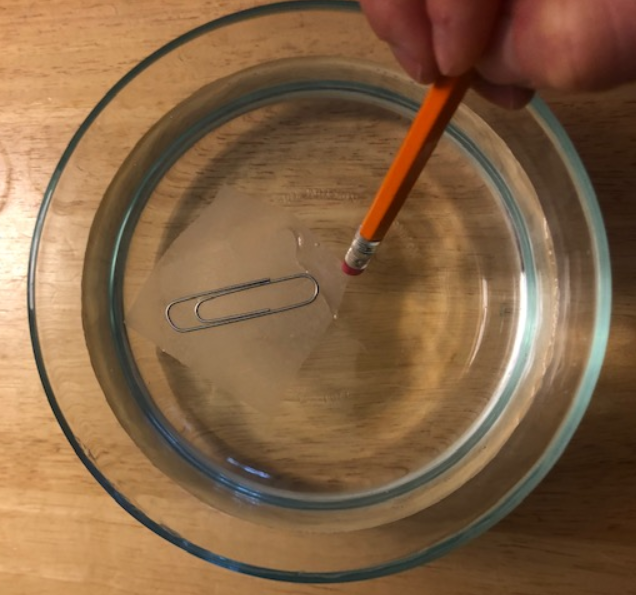
What happens when you drop a paperclip into a bowl of water? Does it sink or float? Normally it sinks, but you can use science to make it float on the surface! Try this: cut out a small square of tissue paper and place it on the surface of a container of water. Place the paperclip on top of the tissue paper. Now, VERY gently and patiently, use the eraser end of a pencil to push the corners of the tissue paper down into the water. Slowly work your way closer and closer to the paperclip without touching it. Once most of the tissue paper is under the water, use the pencil’s eraser to gently push it all the way under the water. The paperclip should remain floating on the surface! It might take a little practice – don’t give up!
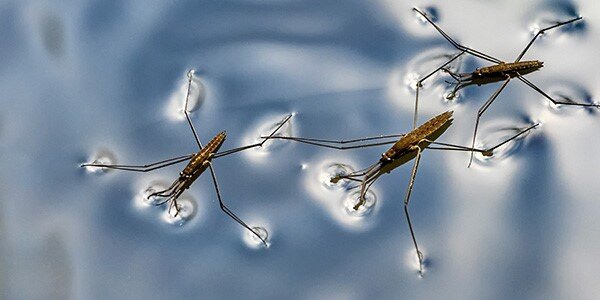
This works because of something called surface tension. The molecules in water are attracted to one another, kind of like tiny magnets. This creates a “film” or “skin” on the surface of the water which can be strong enough to hold up a paperclip. Surface tension also helps some insects, such as water striders, to move across the surface of the water!
Sources:
https://sciencebob.com/make-a-paperclip-float/
https://www.nwf.org/Educational-Resources/Wildlife-Guide/Invertebrates/Water-Striders